




Bathroom accessories are the most overlooked part of a bathroom renovation — and the most regretted. The most common mistakes Indian homeowners make are poor storage planning, choosing the wrong materials for humid conditions, and placing fittings like towel racks and bathroom shelves without thinking about daily use. Getting these decisions right from the start saves money, reduces maintenance, and makes the bathroom genuinely easier to live with.
Why Bathroom Accessories Deserve More Attention Than They Get
Most Indian homeowners spend months choosing floor tiles, wall colours, and sanitary ware. Bathroom accessories often get decided in the final week — quickly, under budget pressure, and without much thought about how the bathroom will actually be used every day.
The result is predictable. Towel racks get installed in inconvenient spots. Bathroom shelves run out of space within a month. Fittings rust within a year. And replacing any of them means drilling into finished walls, risking tile cracks, and starting the disruption all over again.
Here are the seven most common mistakes — and the straightforward fixes that prevent each one.
1. Ignoring Bathroom Storage Planning
▶ The problem: Most homeowners decide on bathroom accessories after the renovation is nearly done. Storage is an afterthought, not part of the original layout.
▶ Why it happens: Tiles, fixtures, and fittings take up most of the planning energy. Nobody sits down with a list of what actually needs to live in the bathroom — shampoos, soaps, razors, towels, cleaning supplies — before choosing what to install.
▶ The fix: Before selecting a single fitting, list every item that needs a home in the bathroom. Then plan your bathroom storage solutions around that list — not the other way around.
A simple exercise: spend one week writing down everything you reach for in your current bathroom. That list tells you exactly how many shelves, hooks, and drawers you actually need.
2. Choosing Low-Quality Bathroom Accessories
▶ The problem: Cheap bathroom accessories look fine in the showroom. Within 12 to 18 months, they rust near brackets, the soap dispenser pump seizes, and towel rings wobble loose from the wall.
▶ Why it happens: Indian bathrooms are genuinely demanding environments. High humidity, hard water, and regular chemical cleaning put fittings under stress that most budget products are not built to handle.
▶ The fix: Look for accessories with a clear material specification. For wet-zone fittings,
stainless steel bathroom accessories are the practical choice — they resist rust, hold up to cleaning products, and do not discolour over time. A quick test in the showroom: run a magnet along the surface. Genuine stainless steel has a weak magnetic response. If the magnet grips firmly, the fitting is mild steel with a chrome coating, which will rust once the surface is compromised.
Buying on price alone is the most expensive decision you can make. A fitting that fails in 18 months costs you the product, the installation labour, and the risk of tile damage when it is removed.
3. Installing the Towel Rack in the Wrong Location
▶ The problem: Towel racks installed directly in the shower splash zone stay permanently damp, develop mould faster, and mean towels never actually dry between uses.
▶ Why it happens: The most common mistake is placing a towel rack wherever there is wall space, rather than where it makes sense for the daily routine.
▶ The fix: Place the primary
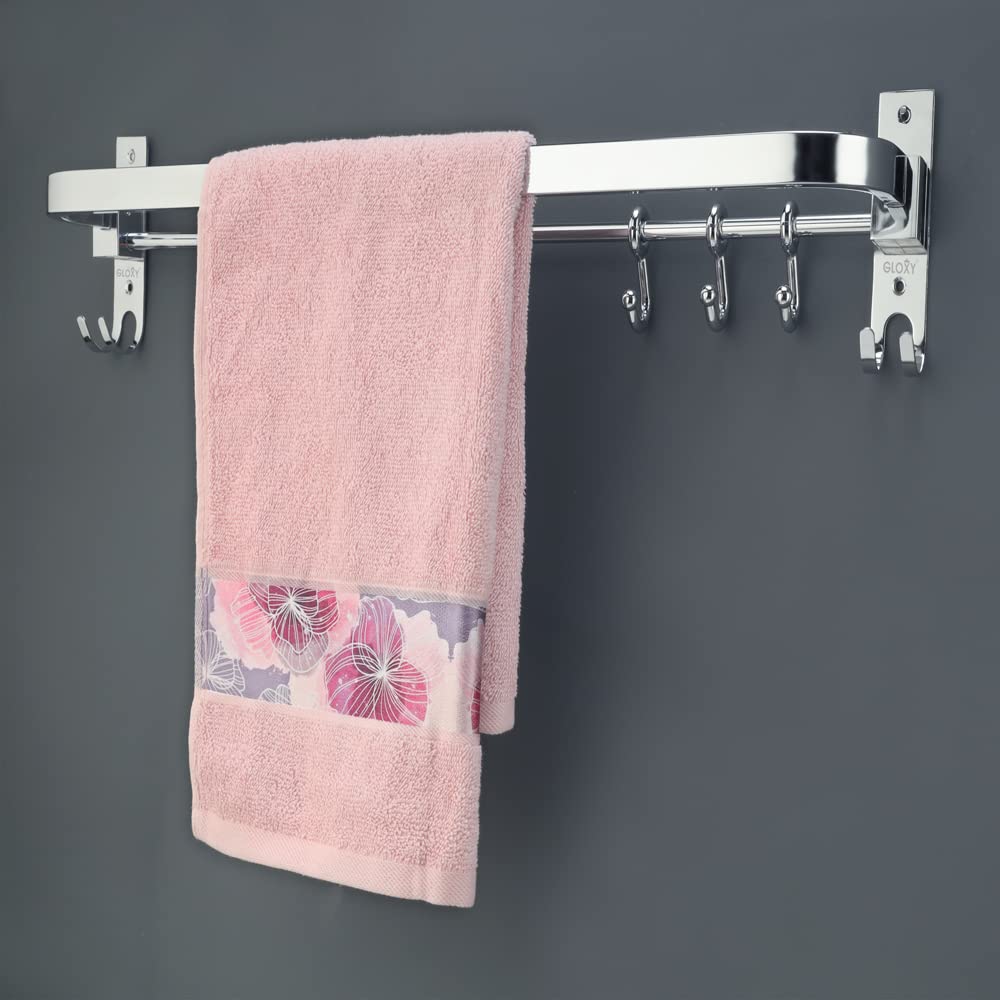
towel rack outside the wet zone — close enough to reach from the shower, far enough to catch good airflow. In compact Indian bathrooms where this is not possible, consider a heated towel rack or a swing-arm rack that pulls out from the wall and tucks back when not in use.
• Allow at least 45 to 50 cm of rail space per towel for proper drying.
• Mount the rack at roughly shoulder height — around 120 to 130 cm from the floor — for easy daily use.
• Avoid the wall directly behind the door where towels get crushed every time the door opens.
4. Not Using Wall-Mounted Storage Solutions
▶ The problem: Small Indian bathrooms feel cluttered and cramped when every product lives on the floor or the edge of the sink.
▶ Why it happens: Homeowners default to countertop storage because it requires no drilling and no planning. But in a bathroom of 25 to 40 square feet — the typical size in most Indian apartments — floor and counter space is simply too limited.
▶ The fix: Vertical wall space is the most underused resource in a small bathroom.
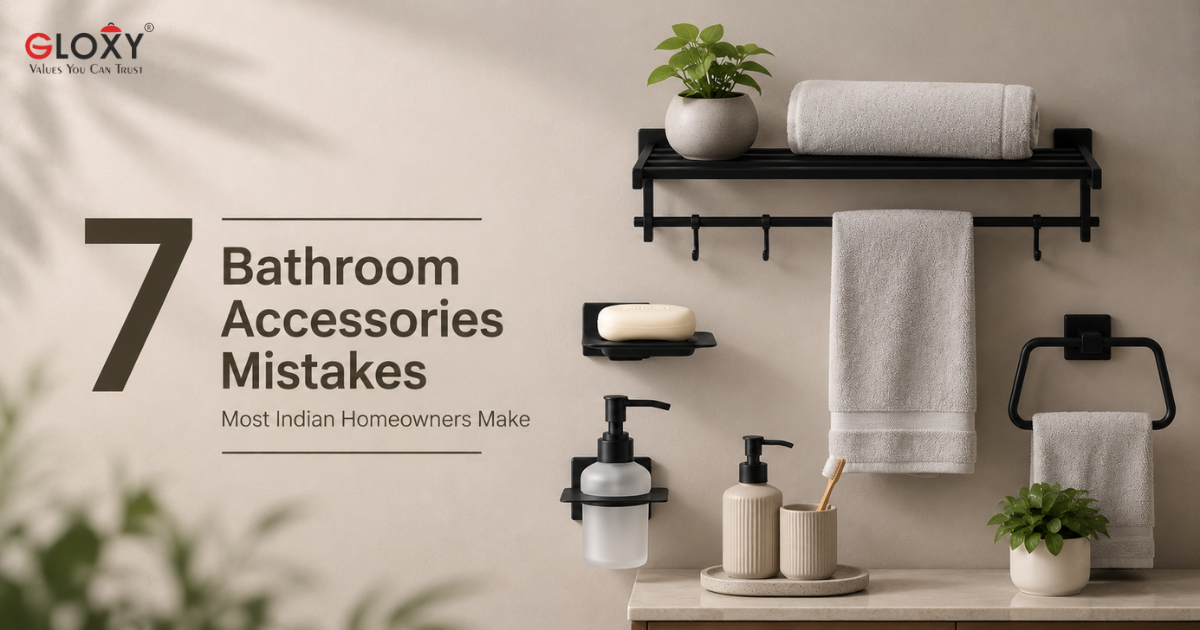
Wall mounted bathroom accessories — dispensers, organisers, hooks, and corner racks — keep the floor clear, make the room feel larger, and put essentials within easy reach without taking up counter space.
The key is planning the mounting points before tiles go up. Decide where each wall fitting will go, mark the positions, and ensure the plumber and tiler work around them — not the other way around.
5. Poor Placement of Bathroom Shelves
▶ The problem: Bathroom shelves that are too high are hard to use daily. Shelves placed inside the shower zone get waterlogged. Shelves without enough depth cannot hold standard shampoo bottles upright.
▶ Why it happens: Shelf placement is usually decided by what looks symmetrical on the wall, not what works at arm’s reach during an actual shower or at the basin.
▶ The fix: Position shelves based on who uses the bathroom and where they will be standing.
Bathroom shelf placement should follow a simple rule: anything you use daily should be reachable without stretching or bending. Shower caddies and in-shower shelves work best at chest to eye level. Vanity shelves near the basin should hold the items used at that spot — face wash, moisturiser, shaving kit — rather than doubling as general storage.
• Minimum shelf depth for shampoo bottles: 15 cm.
• Ideal height for an in-shower shelf: 130 to 150 cm from the floor.
• Corner shelves are consistently the most space-efficient option in compact bathrooms.
6. Ignoring Moisture and Humidity When Choosing Materials
▶ The problem: Bathroom accessories that look premium in a dry showroom begin to degrade in humid bathroom conditions — finishes peel, joints rust, plastic yellows, and screws corrode.
▶ Why it happens: Indian bathrooms, particularly in coastal cities and during monsoon months, deal with sustained high humidity. Most budget accessories are not rated for this environment, and the problem only becomes visible once the fitting is installed and in use.
▶ The fix: Choose materials suited to the wet zone, not just the dry zone.
Stainless steel bathroom accessories handle humidity and cleaning products better than chrome-coated mild steel or low-grade alloys. For accessories with plastic components — soap dispensers, hooks, storage baskets — high-grade ABS plastic holds its colour and structural strength far better than standard plastic, which cracks and yellows within two years of regular bathroom exposure.
Chrome fittings in hard-water areas develop white mineral deposits quickly. A matte or brushed finish shows this far less than high-gloss chrome and requires less frequent cleaning to maintain.
7. Choosing Style Over Functionality
▶ The problem: Decorative accessories that photograph beautifully often fail at their actual job — holding enough towels, staying stable under weight, or fitting standard-sized items.
▶ Why it happens: Social media and interior design inspiration boards prioritise aesthetics. The practical test — does this towel rack hold three wet bath towels without bowing, or does this bathroom shelf fit a full-size shampoo bottle? — rarely features in the images people save and bring to their designers.
▶ The fix: Before buying any fitting, test it for the task it actually needs to perform.
A towel rack should hold multiple towels with no flex at the bracket points. A soap dispenser should cycle smoothly and hold enough soap for a week of use without daily refilling. A bathroom shelf should sit level and stable, not tip forward when a heavy bottle is placed at the front edge.
Good bathroom storage solutions are functional first and attractive second. The best outcome is when both happen together — but when forced to choose, a fitting that does its job reliably every day is a better investment than one that photographs well and frustrates daily.
The Right Bathroom Accessories Make the Room Work
The bathroom accessories you choose determine how organised, durable, and convenient your bathroom is for the next decade. The decisions feel small during a renovation, but a well-placed towel rack, a properly specified bathroom shelf, and the right wall mounted bathroom accessories are the difference between a bathroom that works beautifully from day one and one that creates daily frustrations.
None of the seven mistakes above are difficult to avoid. They simply require making the decision consciously — with real daily use in mind — rather than defaulting to whatever is cheapest, most convenient, or most visually striking at the moment of purchase.
Plan the storage before the renovation. Choose materials that suit the conditions. Place every fitting where it will actually be used. Done right, a well-chosen set of bathroom accessories adds genuine comfort to a space you use every single day.
FAQ
What are the most important bathroom accessories for an Indian home?
The essential bathroom accessories for Indian homes are a rust-resistant towel rack, an adequately-sized bathroom shelf for daily-use products, a soap dispenser, at least two storage hooks, and a wall-mounted cabinet or organisers for bathroom storage solutions. Prioritise function and moisture resistance over decorative style, particularly in bathrooms used by the whole family.
How do I choose the right bathroom shelf for a small Indian bathroom?
Choose a bathroom shelf with a minimum depth of 15 cm to hold standard-sized bottles upright. For small bathrooms, corner shelves maximise space without projecting into the room. Mount shelves at chest to eye level in the shower zone and near the basin at arm’s reach. Stainless steel and tempered glass shelves hold up better than painted wood or low-grade metal in humid Indian bathroom conditions.
Are stainless steel bathroom accessories worth the extra cost?
Stainless steel bathroom accessories are worth the premium in Indian conditions because they resist rust, tolerate hard water, and withstand regular cleaning with strong products. They consistently outlast chrome-coated mild steel or alloy alternatives, and because they do not need replacing every 2 to 3 years, they are the lower-cost option over a 10-year period despite the higher purchase price.


