




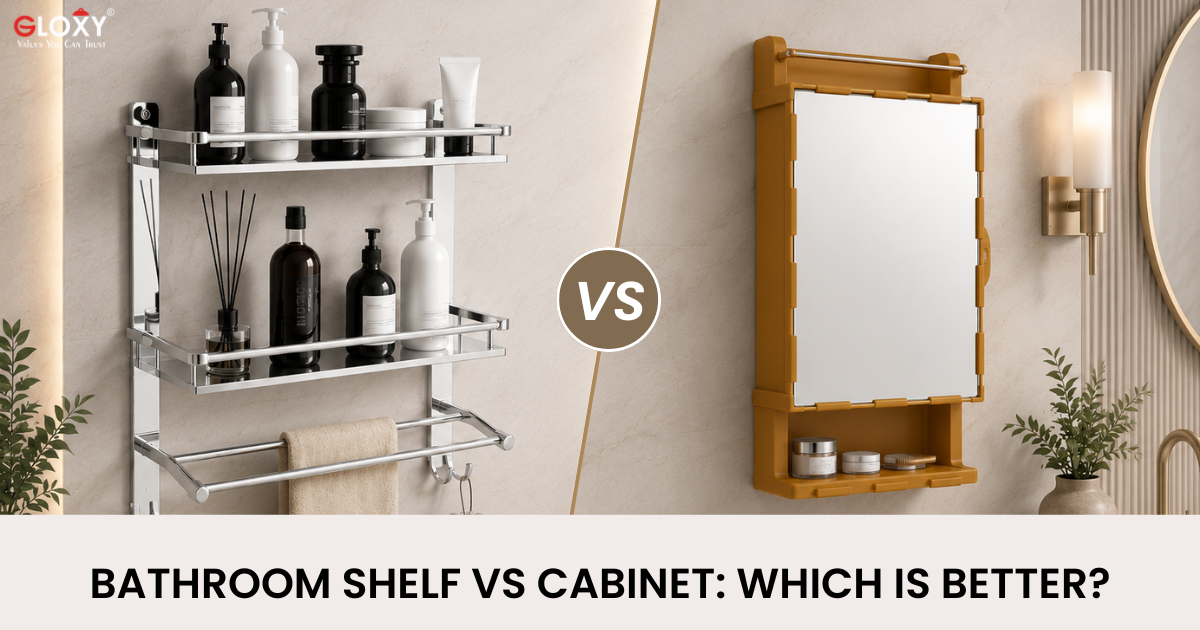
A bathroom shelf is an open, wall-mounted surface that keeps items within reach; a bathroom cabinet is an enclosed unit that protects contents from steam, humidity, and hard water residue. For Indian homes, where bathrooms are typically under 45 sq ft and monsoon humidity spikes regularly, a cabinet offers better protection — but a shelf is lighter, cheaper, and easier to mount. Most bathrooms benefit from one of each, used together.
What a Bathroom Shelf Does Well — and Where It Falls Short
An open shelf puts shampoo, soap, and a spare towel within arm's reach without opening a door. That convenience is real, especially in a rushed morning routine.
Shelves are also far easier to mount in Indian apartments. A standard wall shelf needs only two to four anchor points in an RCC wall, compared to six or eight for a heavier cabinet. For renters, or anyone in an apartment with thin partition walls, a shelf is often the only practical option.
The limitation is exposure. In bathrooms with direct shower splash or high-TDS water — above 300 ppm, common across Delhi, Bengaluru, and Chennai — items on open metal shelves develop rust stains and packaging damage faster than most buyers expect.
Why a Bathroom Cabinet Earns Its Price
The case for a cabinet is not aesthetics — it is moisture protection. Medicines, skincare with paper packaging, and electric shavers will last significantly longer inside a closed unit than on an open shelf in a steamy bathroom.
A 10-minute hot shower can raise humidity inside a small Indian bathroom to above 80%. PVC bathroom cabinets handle this without warping. MDF cabinets do not — unless every cut edge is properly sealed, which most budget options are not.
Before purchasing any wall cabinet, tap the mounting wall. A solid, dense sound means RCC concrete — use 8–10 mm Fischer-type masonry anchors. A hollow sound means a partition wall; get a professional assessment before mounting anything over 4 kg.
Bathroom Shelf vs Bathroom Cabinet: Side-by-Side

Choose a Shelf When
• Your bathroom is under 40 sq ft and a cabinet's depth would restrict movement
• You want to store towels, plants, or soap — items that handle steam without damage
• Your wall is a hollow partition that cannot safely bear a cabinet's weight
• You are renting and want minimal anchor holes in the wall
• Your budget is under ₹2,000 and you need a quick, functional fix
Choose a Cabinet When
• You store medicines or paper-packaged skincare that degrades in humidity
• Your water TDS is above 300 ppm — hard water residue on open shelves becomes a daily cleaning problem
• Your family bathroom serves four or more people and needs more compartmentalised storage
• You want a tidy bathroom without reorganising every morning
• You want a mirror included — a bathroom mirror cabinet eliminates the need for a separate mirror and a separate storage unit
The Mirror Cabinet: The Practical Answer for Most Indian Bathrooms
The most common storage choice for Indian apartment bathrooms is a mirror cabinet above the washbasin — and the reason is straightforward.
A mirror cabinet solves three things at once: enclosed storage, a full-size grooming mirror, and no need for a separate wall fixture. In a bathroom where every centimetre of wall space counts, that consolidation delivers more value than a cheaper standalone shelf.
Choose PVC over MDF, in the 45–60 cm wide range, with a maximum depth of 15 cm. That depth prevents the cabinet from becoming an obstacle in a compact layout. Gloxy's bathroom mirror cabinets are built to Indian apartment dimensions — full PVC construction, moisture-resistant, and wall-ready for RCC or brick installation.
Once the mirror cabinet is in place, a single stainless steel shelf near the shower covers overflow items — towels, a loofah, shower gels — without requiring a second cabinet.
The Right Bathroom Storage Combination for Indian Homes
For the typical Indian apartment — compact, humid, hard water — the bathroom shelf vs bathroom cabinet decision usually resolves to this:
• One PVC mirror cabinet (45–60 cm wide, 12–15 cm deep) above the washbasin for medicines, skincare, and daily essentials
• One stainless steel shelf near the shower for towels, soaps, and items that need open access
If budget forces a choice, start with the mirror cabinet. It stores more, protects better, and replaces a bathroom mirror you would need to buy separately — making it the better value per rupee spent.
FAQ
Is a bathroom shelf or bathroom cabinet better for small bathrooms in India?
A bathroom mirror cabinet with a 12–15 cm depth is the better choice for bathrooms under 40 sq ft. It combines enclosed storage and a full mirror in one wall-mounted unit without reducing floor space. Add a stainless steel shelf near the shower for towels and daily-use items.
Can I install a bathroom cabinet on an RCC concrete wall myself?
Yes — but you need a hammer drill and 8–10 mm Fischer-type masonry anchors rated for at least twice the cabinet's weight. A standard drill will not penetrate RCC cleanly, and misaligned holes are difficult to correct in concrete, so mark all anchor points before drilling.
Which is the best material for a bathroom cabinet in India — PVC, MDF, or stainless steel?
PVC is the most durable and low-maintenance material for Indian bathrooms. It does not absorb moisture, does not warp in monsoon humidity, and resists hard water staining. MDF swells if cut edges are unsealed; stainless steel is durable but heavier and requires regular wiping in hard water areas.


