




A neighbour in Ahmedabad picked a fixed sink faucet because it looked neat in the showroom. Within a week, her double-bowl sink's far corner was out of reach, and she switched to a flexible one.
Most people choose on looks and price alone, without checking if the faucet reaches where they need it. The right pick depends on your sink layout, water pressure, and how much daily convenience is worth to you.
What's the Difference: Sink Faucet vs Flexible Faucet

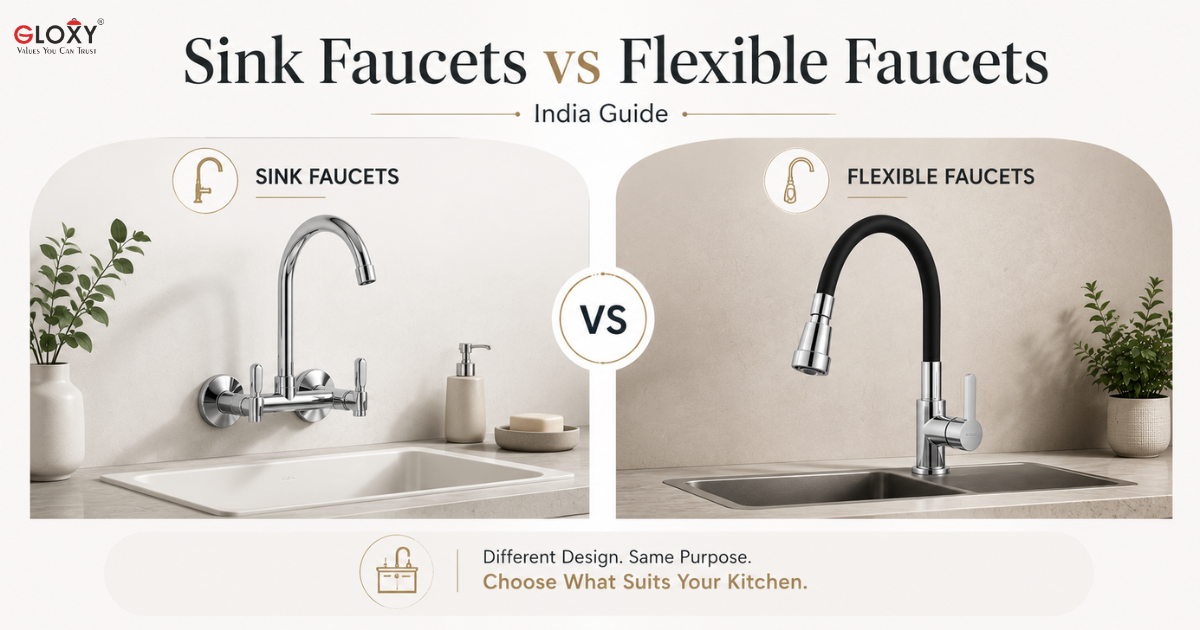
A sink faucet has a rigid spout, so you move your utensils to the water. It's simple and costs less.
A flexible faucet has a spray head on a retractable hose that pulls toward you or down into the sink, giving real reach across double-bowl sinks — though it has more parts that can wear.
|
🔧 Expert Note Neither type is objectively better. A fixed faucet in a small single-bowl kitchen will outlast a flexible one you didn't need. The hose only earns its cost when your sink genuinely needs the reach. |
Material Comparison: Brass, Steel or Zinc Alloy

Brass is the traditional choice for Indian plumbing — it resists hard water well and takes chrome, matte black or PVD finishes cleanly.
Stainless steel, SS304 inland or SS316 near the coast, is the other dependable option for a fingerprint-resistant look.
Zinc alloy is where budget faucets cut corners: cheaper, but the plating can flake within a year or two once hard water reaches it.
How Indian Water Conditions Decide Your Choice
Rajasthan, Gujarat, Delhi, Haryana and parts of South India have hard water with high calcium and magnesium. Under BIS IS 10500:2012, the acceptable hardness limit is 200 mg/L, with up to 600 mg/L permitted where no better source exists. Brass and a good ceramic disc cartridge cope with this far better than zinc.
Many Indian apartments, especially on upper floors, also deal with low water pressure. A flexible faucet's aerator mixes air into the stream, keeping the flow feeling steady.
|
Buyer Tip Unsure about your building's pressure? Ask your plumber first — a wider aerator opening copes better with weak pressure. |
5 Buying Mistakes to Avoid
- Fixed faucet on a double-bowl sink — daily lifting across the counter.
- Ignoring hose material — thin hoses fail first.
- Zinc alloy in a hard water area — chipped plating corrodes fast.
- Skipping the aerator check in low-pressure homes.
- Not counting mounting holes before buying.
Brass fixed faucets typically run ₹1,500 to ₹9,000 depending on finish; flexible versions add roughly ₹500 to ₹2,000 more, indicative only.
According to Mordor Intelligence, the India faucets market was valued at around USD 1.76 billion in 2025, projected to reach USD 2.66 billion by 2031.
Maintenance Tips
Wipe down after use in hard water areas, check the hose connection on flexible faucets occasionally, and skip harsh scouring pads on matte black or PVD finishes.

How to Choose: A Simple Decision Framework
Check sink layout first — double bowl or deep basin means go flexible. Then check water pressure, and match material to local water hardness. Decide budget and finish last.
Gloxy's sink faucets and flexible faucets collections let you compare by material and price side by side.
Conclusion
Choosing between a sink faucet and a flexible faucet isn't about looks — it's about matching your sink, your water, and your daily habits. A fixed faucet suits a simple single-bowl kitchen well; a flexible one earns its price the moment you have a double bowl, deep basin, or pressure that needs a boost.
FAQ
What is a flexible faucet and how is it different from a normal sink faucet?
A flexible faucet has a pull-out or pull-down spray head on a hose. A sink faucet has a fixed spout with no moving hose.
Which material is best for a sink faucet in India?
Brass is generally safest for hard water, with SS316 a strong alternative near the coast. Avoid zinc alloy in hard water regions.
Is a flexible faucet good for low water pressure?
Yes — most have an aerator that helps maintain a steady stream even at lower supply pressure.
How much does a flexible kitchen faucet cost in India?
A stainless steel flexible faucet usually starts around ₹1,800 to ₹3,000, while brass versions range from about ₹2,500 up to ₹15,000 depending on finish.


