




A few months ago, a homeowner in Kolkata told me about the wall mixer tap he had ordered online. The photo looked perfect — sleek dual levers, chrome finish, exactly the look he wanted for his new bathroom. The problem showed up when the plumber arrived. The unit he had bought was a plain non-shower mixer, but his bathing area was already plumbed for an overhead shower. Wrong inlet spacing, no shower provision, and a bend pipe that did not line up. The tap went back, a week was lost, and the replacement cost more than the original.
That story is more common than you would think, because the wall mixer is almost always picked on looks alone. It is one of the hardest-working fittings in an Indian bathroom — it runs hot and cold every single day, it lives in a wet, humid corner, and yet the questions that actually decide whether it lasts (Is the body real brass? Does it support my overhead shower? Will it survive my water?) get skipped at the checkout.
After years of helping homeowners, plumbers and interior designers choose fittings, I have found the good decisions follow a simple order: sort out the type and plumbing first, then the material, then your water and budget, and choose the finish last. This guide walks through that order so the wall mixer you fit today is still one you are happy with five years from now.
There is real depth to this category too. India's faucet market has been growing steadily for years, with bathroom taps making up a large share of demand. More choice reaches Indian buyers every year, which makes a clear way of deciding more useful, not less.
What Is a Wall Mixer Tap?

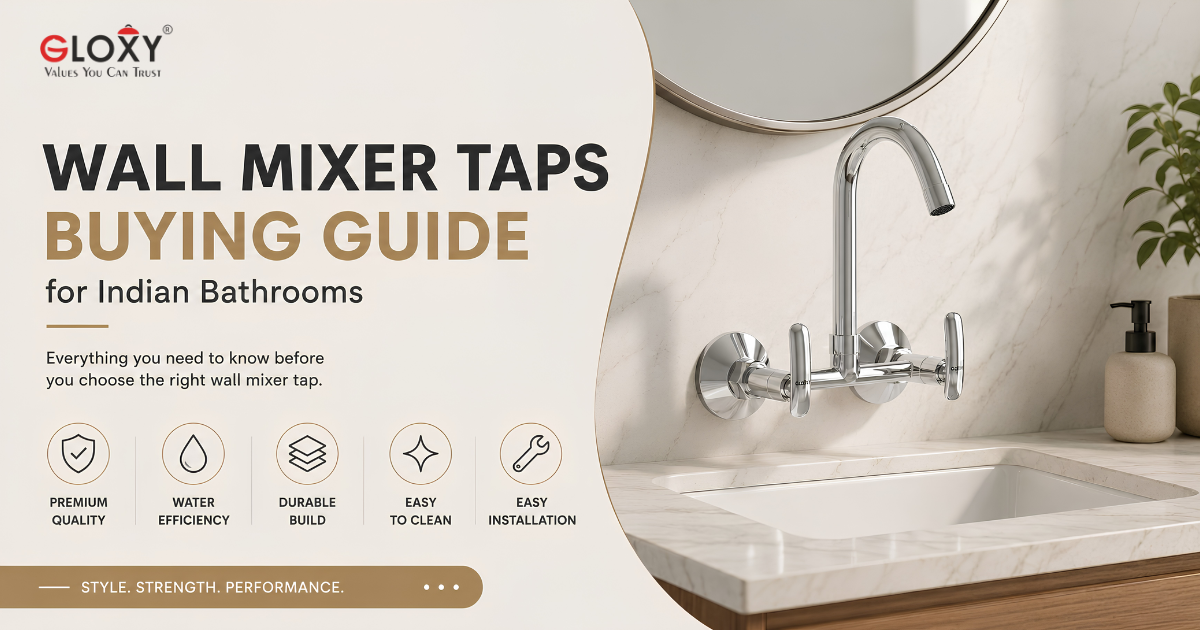
A wall mixer tap is a wall-mounted fitting that blends hot and cold water in a single body before sending it out through a spout, a hand shower, or an overhead shower. Instead of two separate taps, you get one unit with a lever (or two) to control flow and temperature.
In Indian homes it is the standard fitting for the bathing area — above the bucket-and-mug spot, the bathtub, or the shower zone. The pipework comes out of the wall, the body sits flush against it, and depending on the model it may also feed an overhead shower through a diverter.
Expert Note "Tap" and "faucet" mean the same thing here. A wall mixer is simply a mixer (hot and cold in one) that mounts on the wall rather than on the basin or counter.
Types of Wall Mixer Taps You'll See in India
This is where most of the confusion lives, so it is worth getting right before you look at finishes. The names on Amazon, Moglix and local shops can be baffling, but they come down to a handful of types.
| Type | What it does | Best for |
|---|---|---|
| Single-lever wall mixer | One lever controls hot, cold and flow together | Modern bathrooms; one-hand convenience |
| 2-in-1 wall mixer | Dual levers feeding a spout, with provision for an overhead shower | Most Indian bathing areas with an overhead shower |
| 3-in-1 wall mixer | Adds a diverter to switch between spout, overhead and hand shower | Setups with both a hand shower and overhead shower |
| Telephonic wall mixer | Comes with a crutch and a flexible hand-shower hose | Homes that want a handheld shower at the wall |
| Non-telephonic wall mixer | No hand-shower hose; spout or overhead provision only | Simple, low-maintenance bathing setups |
| Concealed wall mixer | Body hidden inside the wall; only the lever and plate show | New builds; premium, minimalist bathrooms |
A quick word on the two terms that trip people up most. "Telephonic" just means the mixer includes a handheld shower on a flexible hose (it looks a bit like an old telephone handset on a cradle). "Non-telephonic" means it does not. Neither is better — it depends on whether you want a handheld shower at that point in the bathroom.
Buyer Tip Before you buy anything, look at how your bathing area is already plumbed. If there is an overhead shower arm coming out of the wall, you want a mixer with overhead-shower provision. If you want a handheld shower, look for a telephonic model. Matching the mixer to your existing plumbing prevents the single most common return.
2-in-1 vs 3-in-1: Which Should You Buy?
These two are the most cross-shopped, so here is the honest difference.
| Feature | 2-in-1 wall mixer | 3-in-1 wall mixer |
|---|---|---|
| Outlets | Spout + overhead shower | Spout + overhead + hand shower |
| Diverter | Simple / single diversion | Full diverter to switch outlets |
| Best for | Standard bathing area with an overhead shower | Bathrooms using both overhead and handheld showers |
| Price | Lower | Slightly higher |
| Watch-out | No handheld shower | More moving parts to maintain |
For most Indian bathrooms with one overhead shower, a well-made 2-in-1 covers everything you actually use. Go to 3-in-1 only if you genuinely want a handheld shower alongside the overhead one — for bathing kids or elderly family members, washing the area down, or filling a bucket comfortably.
Which Material Lasts: Brass vs Zinc vs Stainless Steel
The design is what you see. The material is what you live with. In hard water and humidity, a cheap body fails long before the style ever dates.
| Material | Durability | What to know |
|---|---|---|
| Brass | Excellent; resists corrosion and hard water | Solid, heavy, premium — the trusted choice for a daily-use tap |
| Zinc alloy | Weak; corrodes once the plating chips | Budget, usually chrome-plated; poor for a daily wall mixer |
| Stainless steel | Very good; rust-resistant | Clean, modern, often matte; a solid alternative to brass |
The Cartridge Question
Material is not only about the body. The cartridge — the part inside that actually opens and closes the water — decides whether your mixer drips in a year or stays tight for a decade.
- Ceramic disc cartridge: handles hard water far better, gives a smooth quarter-turn feel, and resists the slow drip that stains tiles. This is what you want.
- Rubber washer: cheaper, but wears faster and starts dripping sooner.
Expert Note Two things separate a wall mixer that lasts from one that fails early. First, a brass body rather than zinc alloy — pick the heavier of two similar taps in your hand and it is usually the brass one. Second, a ceramic disc cartridge rather than a rubber washer.
Also look for the ISI mark as a basic assurance the product meets Indian quality standards. Gloxy's wall mixers are built on brass bodies for exactly this reason.
Wall Mixers in Indian Conditions: Hard Water and Pressure
This is the part most guides skip, and it is the part that decides whether your mixer still works smoothly in a few years.
Hard Water
Much of Gujarat, Rajasthan, Punjab, Haryana and parts of South India runs hard. Under the BIS drinking water standard (IS 10500:2012), the acceptable limit for total hardness is 200 mg/L, stretchable to 600 mg/L where there is no better source. The harder your water, the more a high-shine chrome tap shows every droplet and scale mark. Matte and brushed finishes hide this far better, and a ceramic-disc cartridge copes better with mineral-heavy water.
Low Water Pressure
Many Indian buildings — especially ground floors and older overhead-tank setups — run at low pressure. A good aerator keeps the flow feeling steady and splash-free even when pressure dips. If your line is weak, choose a mixer with an easy-to-clean aerator and keep a spare; in hard water the aerator mesh clogs, and a two-minute clean restores the flow.
Buyer Tip If you live in a hard-water belt, do not fall for a mirror-chrome mixer just because it sparkles in the shop. Within weeks it shows every spot. Matte, brushed, or a good chrome with a quality finish saves you daily scrubbing.
Wall Mixer Tap Price in India (2026)
Price tracks material, finish, the type of mixer, and the brand name on the box. The ranges below are indicative of the Indian retail market — use them to set expectations, not as fixed quotes. The value range covers budget to mid-range options.
| Type | Value range (₹) | Premium (₹) |
|---|---|---|
| 2-in-1 wall mixer (brass) | 1,500 – 4,500 | 4,500 – 10,000+ |
| 3-in-1 wall mixer (brass) | 2,000 – 6,000 | 6,000 – 14,000+ |
| Telephonic wall mixer set | 2,500 – 7,000 | 7,000 – 16,000+ |
| Concealed wall mixer | 3,000 – 9,000 | 9,000 – 25,000+ |
A lot of the premium price is the brand, not the build. A solid brass 2-in-1 with a ceramic cartridge in the mid band will often outperform a flashier, lighter unit costing far more. For context, Gloxy's brass wall mixers with overhead-shower provision sit around ₹2,999 — comfortably in everyday-value territory while keeping the brass body and overhead support that actually matter.
Buyer Tip The wall mixer is touched and stressed every day. Spend one tier higher than you would on a rarely used fitting — a brass mixer with a ceramic cartridge is far cheaper than replacing a corroded, dripping budget unit in two seasons.
Installation Basics: What to Check Before You Order
A surprising share of returns happen because the mixer simply did not fit the wall. A few checks prevent it.
- Inlet centre distance: the gap between the two wall inlets (hot and cold) is usually a standard spacing, but measure yours before ordering. A mismatch means the mixer will not seat cleanly.
- Overhead-shower provision: if you have an overhead arm, confirm the mixer is designed to feed it. Not every wall mixer has this outlet.
- Bend pipe / crutch: telephonic models come with a bend pipe and crutch for the hand shower — check these are included and suit your wall.
- Flush the lines first: before the plumber fits the mixer, run the pipes to clear grit and debris. Construction debris is a leading cause of early cartridge damage.
Expert Note A two-minute measurement at home — inlet spacing plus a glance at your overhead-shower arm — prevents the most common and most avoidable installation headache. If you are a contractor or plumber ordering in volume, confirming these specs once across a project saves a lot of site rework.
5 Wall Mixer Buying Mistakes to Avoid
- Buying a zinc-alloy body for daily use. Once the plating chips, hard water finishes it off. Choose brass or stainless steel.
- Mixing up telephonic and non-telephonic. Decide first whether you actually want a handheld shower at that point — then buy accordingly.
- Ignoring overhead-shower provision. If your bathroom has an overhead arm, a plain mixer will not feed it. Match the outlet to your plumbing.
- Skipping the inlet-distance check. The most avoidable return of all. Measure before you order.
- Forgetting the cartridge. A rubber washer drips sooner. Insist on a ceramic disc cartridge.
Maintenance: Keep It Working and Shining
Wall mixers are low-maintenance, but a few habits make a real difference in Indian conditions.
- Operate gently. A smooth turn is enough. Forcing stiff levers wears the internal parts and causes leaks over time.
- Wipe after use. A soft, damp cloth removes water spots and soap film before they settle.
- Descale with vinegar. For hard-water marks, a mix of equal parts white vinegar and water works better — and is gentler — than harsh acidic cleaners that dull the finish.
- Clean the aerator. Every few months, unscrew the spout tip and clear the mesh. In hard water it clogs and weakens the flow.
- Check yearly. Have a plumber glance at the joints and cartridge once a year, especially in low-pressure or hard-water areas. A small tightening now prevents a bigger repair later.
Finish-specific care: chrome — wipe dry to avoid spotting, skip abrasive scrubbers; matte black and brushed — mild soapy water only, no metal polishes.
How to Choose: A Simple 4-Step Framework

When clients want it made easy, I give them this order. Answer each step and the shortlist almost builds itself.
- Check your plumbing first. Overhead shower? You need overhead provision. Want a handheld shower? Go telephonic. Just a spout? A simple 2-in-1 is enough.
- Match the material. Daily-use mixer in hard water or humidity — brass body, ceramic cartridge, no compromise.
- Set your water and budget honestly. Hard water leans you toward matte/brushed finishes; pick a price tier one step up from a rarely used fitting.
- Then choose the look. Chrome, matte black, brushed — decide this last. By now most options are already ruled in or out.
The Gloxy Wall Mixer Range (A Value Pick)
If you have worked through the framework and landed on a brass 2-in-1 with overhead-shower provision at a fair price, Gloxy's range is worth a look. All three are dual-lever hot-and-cold brass wall mixers with overhead-shower provision, priced around ₹2,999.
| Model | What you get | Price |
|---|---|---|
| Gloxy Imperial | Brass, dual-lever 2-in-1, overhead-shower provision | ~ ₹2,999 |
| Gloxy Jet+ | Brass, dual-lever 2-in-1, overhead-shower provision | ~ ₹2,999 |
| Gloxy Nano | Brass, dual-lever 2-in-1, overhead-shower provision | ~ ₹2,999 |
The differences between them are mostly in styling, so you can choose on looks once the build and function are settled — which is exactly the order this guide recommends.
A Quick Vastu Note
For many Indian families, water flow in the bathroom carries some significance. Common Vastu guidance suggests keeping taps in good repair, since a dripping tap is seen as wasteful. There is no single rule everyone follows, so treat it as one consideration among the practical ones — a well-maintained, leak-free wall mixer sits comfortably with most advice anyway.
Conclusion
The best wall mixer tap is not the trendiest one — it is the one that fits your plumbing, survives your water, and feels right every time you reach for it. For most Indian bathrooms, a brass 2-in-1 with overhead-shower provision and a ceramic cartridge covers everything you actually use. Decide with your plumbing first, material second, water and budget third, and the finish last. Get that order right, and you will fit it once and forget about it for years.
Frequently Asked Questions
What is a wall mixer tap?
A wall mixer tap is a wall-mounted fitting that blends hot and cold water in one body and sends it out through a spout, a hand shower, or an overhead shower. It is the standard fitting for the bathing area in most Indian bathrooms.
What is the difference between a 2-in-1 and a 3-in-1 wall mixer?
A 2-in-1 feeds a spout with provision for an overhead shower. A 3-in-1 adds a diverter so you can switch between the spout, an overhead shower, and a handheld shower. Choose 3-in-1 only if you genuinely want a handheld shower as well.
What does telephonic and non-telephonic wall mixer mean?
Telephonic means the mixer includes a handheld shower on a flexible hose, mounted on a crutch. Non-telephonic has no hand shower. Pick based on whether you want a handheld shower at that point in the bathroom.
Which material is best for a wall mixer — brass or stainless steel?
Brass is the trusted choice for daily-use mixers because it resists corrosion and hard water well. Stainless steel is a good modern alternative. Avoid zinc alloy for a daily wall mixer, as it fails once the plating chips. Look for a ceramic disc cartridge either way.
How much does a wall mixer tap cost in India?
Indicatively, a quality brass 2-in-1 wall mixer runs from roughly ₹1,500 to ₹10,000 depending on finish and brand, while 3-in-1, telephonic and concealed models start higher. Value-focused brass options with overhead provision are widely available around ₹3,000.
Can a wall mixer be used with an overhead shower?
Yes, but only if the model has overhead-shower provision. Check that the mixer has the outlet for it and that your wall already has an overhead arm before ordering.
How do I clean a wall mixer in a hard-water area?
Wipe it dry after use, descale marks with a half-vinegar, half-water mix, and clean the aerator mesh every few months. Avoid harsh acidic cleaners, which dull the finish over time.


