




|
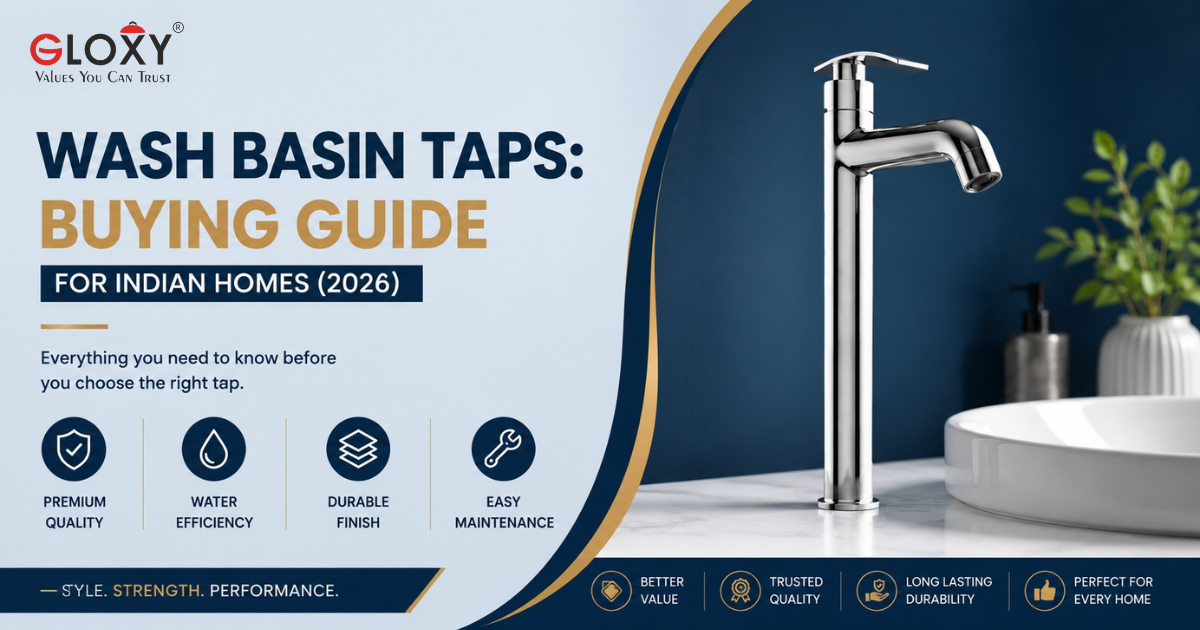
Wash basin taps are the faucets fitted to a bathroom basin, and in Indian homes they fall into five main types: pillar taps, single-lever basin mixers, two-hole (centerset) mixers, wall-mounted taps, and sensor taps. The right one is decided by three things — your basin's hole layout, your local water quality, and your budget — not just by how the tap looks in the showroom. |
A neighbour of mine in Rajkot ordered a sleek single-lever mixer online because it looked perfect for his new vanity. When the plumber arrived, the basin had two separate tap holes — the mixer needed one. The tap went back, a week was lost, and the replacement cost more than the original.
That mix-up happens constantly, because the wash basin tap is usually picked on appearance alone. It is one of the most-touched fittings in the house, it faces water all day, and yet the questions that actually matter — does it fit the basin, will the finish survive my water, is the body solid metal — get skipped.
After years of helping homeowners, plumbers and interior designers specify fittings, I have learned the good choices come down to a simple order: sort out the basin and water first, then the budget, and choose the look last. This guide walks through the bathroom wash basin taps you will actually see in Indian homes and helps you land on the one that suits your basin.
There is real depth to this category, too. According to Mordor Intelligence, India's faucet market was worth roughly USD 1.89 billion in 2026 and is projected to reach about USD 2.66 billion by 2031, with bathroom basin taps making up the bulk of that demand. More choice is reaching Indian buyers every year — which makes a clear way of deciding more useful, not less.
The types of wash basin taps you'll actually see in India
Before the “wall vs deck” debate, it helps to know the actual tap types, because the type often decides the mount.

1. Pillar tap
A single tap fixed into one hole on the basin, with one spout and one handle. Traditionally cold-only, so older Indian basins often have two pillar taps side by side — one for each line. Simple, cheap, and easy to replace.
|
Best for: budget setups, guest or utility basins, and homes that don't need hot water at the basin. |

2. Single-lever basin mixer
One handle mixes hot and cold, fitted through a single hole. The default in most modern Indian flats — quick to operate with one hand, and a clean look.
|
Best for: master and family bathrooms, modern single-hole basins, everyday convenience. |

3. Two-hole / centerset mixer
Separate hot and cold handles with a central spout, fitted to a basin with two or three pre-drilled holes. Suits classic and semi-traditional bathrooms.
|
Best for: basins that already have two or three holes; a more traditional look. |
4. Wall-mounted basin tap
The spout and handles come out of the wall, with all the pipework concealed inside it. The basin top stays completely clear. Striking with counter-top (vessel) basins.
|
Best for: new builds and full renovations, vessel basins, minimalist bathrooms. |

5. Sensor (touchless) tap
Water flows when hands come near the spout. Increasingly seen in homes with elderly members and in commercial washrooms for hygiene.
|
Best for: hands-free hygiene, kids, clinics, high-traffic basins. |
|
🔧 Expert Note Pillar tap vs mixer is the first fork in the road. If your basin has one hole, you want a pillar tap or a single-lever mixer. If it has two or three holes, you want a centerset mixer or twin pillar taps. Get this right before you even think about finish. |
Wall-mounted vs deck-mounted wash basin taps
This is the comparison most people search for, so it deserves a clear answer. A deck-mounted tap sits on the basin or counter; a wall-mounted tap comes out of the wall with hidden pipes. In India, the practical realities tilt the decision more than the looks do.
|
Factor |
Deck-mounted |
Wall-mounted |
|
Installation |
Fits existing basin holes; finished in under an hour. Ideal for retrofits. |
Needs concealed in-wall plumbing; best planned during construction. |
|
Counter clutter |
Tap base sits on the surface. |
Basin top stays completely clear. |
|
Cleaning |
Grime and limescale gather around the base. |
Nothing on the basin to clean around. |
|
Repairs |
Connections accessible under the basin; cheap to fix. |
A fault means opening the wall; slow and costly. |
|
Basin compatibility |
Works with almost any standard pre-drilled basin. |
Needs a basin without tap holes; plan basin + tap together. |
|
Cost |
Lower tap and installation cost. |
Higher, mainly from the in-wall work. |
Mordor Intelligence notes that in India, upgrading to wall-mounted taps during a renovation often means chiselling tiles, which pushes labour costs up — so retrofit projects tend to favour deck-mounted fittings. Wall-mounted taps make most sense in metros and compact homes where a clear counter is worth the extra effort. For that route, browse wall mixer taps.
WALL-MOUNTED — PROS & WATCH-OUTS
|
✔ Pros |
✕ Watch-outs |
|
Clean, premium look |
Expensive to fit and repair |
|
Completely clear basin |
Needs planning before tiling |
|
Easy to wipe |
Not practical to retrofit |
|
Ideal for vessel basins |
|
DECK-MOUNTED — PROS & WATCH-OUTS
|
✔ Pros |
✕ Watch-outs |
|
Easy and affordable to install |
Base collects water and soap |
|
Fits most basins |
Takes a little counter space |
|
Simple repairs |
|
|
Huge range of styles |
|
|
Buyer tip: For an existing bathroom you are simply upgrading, deck-mounted is almost always the sensible call. Save wall-mounted for a fresh build or full renovation where the wall is already open. |
Which material lasts in Indian conditions: brass vs zinc vs stainless steel
The design is what you see; the material is what you live with. In hard water and humidity, a cheap body fails long before the style dates. For a deeper material comparison, see durable bathroom fittings.
|
Material |
Look & feel |
Durability |
Cost |
Notes |
|
Brass |
Solid, heavy, premium |
Excellent; resists corrosion and hard water |
Mid–premium |
The trusted long-term choice; close to half of India's faucet revenue (Mordor). |
|
Zinc alloy |
Budget styles, often chrome-plated |
Weak; corrodes once plating chips |
Budget |
Fine for low-use basins; poor for a daily-use tap in hard water. |
|
Stainless steel |
Clean, modern, often matte |
Very good; rust-resistant |
Mid |
A solid alternative to brass, especially for a contemporary look. |
|
🔧 Expert Note Two things separate a tap that lasts from one that leaks in a year: • A brass body, not zinc alloy. A heavier tap in the hand is usually the brass one. • A ceramic disc cartridge, not a rubber washer. Ceramic discs handle India's hard water far better and stop the slow drip that stains the basin. Also look for the ISI mark — your basic assurance the tap meets Indian quality standards. |
Gloxy's range leans on brass-body construction for this reason — you can filter the brass faucets collection by style and finish.
How Indian water quietly decides your finish
This is the part most guides skip, and it is the part that decides whether your tap still looks good in five years.
|
💧 Hard water Much of Gujarat, Rajasthan, Punjab, Haryana and parts of South India runs hard. Under BIS IS 10500:2012, the acceptable limit for total hardness (as calcium carbonate) is 200 mg/L, stretchable to 600 mg/L where no better source exists. The harder your water, the worse a shiny chrome tap looks. Matte and brushed finishes hide this beautifully, and a ceramic-disc cartridge copes far better with mineral-heavy water. |
|
☔ Monsoon humidity Months of damp air speed up corrosion on poorly plated metals. Brass or stainless steel bodies shrug it off; bare zinc alloy does not. |
|
🌊 Coastal salt air Near the sea — Mumbai, Goa, Chennai, Kochi, Visakhapatnam — salt is brutal on plated hardware. A solid brass body with a PVD or quality finish will outlast a plated zinc tap by years. |
|
Buyer tip: If you live in a hard-water belt, don't buy a high-shine chrome basin tap, however good it looks in the shop. Within weeks it will show every drop. Matte black, brushed steel or PVD finishes save you daily scrubbing. |
Sizing and fixing: how many holes does your basin need?
A surprising share of returns happen because the tap simply didn't match the basin. Two numbers prevent it: how many tap holes your basin has, and the spout reach you need.
|
Basin holes |
Tap type |
Note |
|
One hole |
Pillar tap or single-lever mixer |
Most modern flats; the simplest, most common setup. |
|
Two holes |
Twin pillar taps or two-hole arrangement |
Older or semi-traditional basins. |
|
Three holes |
Centerset / three-hole mixer |
Wider basins and classic styles. |
|
No holes (vessel) |
Wall-mounted tap or tall vessel mixer |
Basin and tap must be planned together. |
Spout reach matters too: the water should land near the centre of the bowl, not at the back edge or over the front lip. A vessel basin needs a tall spout; a standard inset basin takes a regular height.
|
🔧 Expert Note Before you order anything online, count the holes in your basin and measure roughly where the spout needs to reach. A two-minute check at home prevents the most common — and most avoidable — installation headache. |
How much do wash basin taps cost in India?
Price tracks material, finish and whether it is a simple tap or a mixer. The ranges below are indicative figures from the Indian retail market — use them to set expectations, not as fixed quotes. A brass body and a good finish push prices up the band. (See also affordable bathroom upgrades.)
|
Type / material |
Budget |
Mid-range |
Premium |
|
Pillar tap (single) |
₹300–800 |
₹800–1,500 |
₹1,500–3,000+ |
|
Single-lever basin mixer |
₹800–1,500 |
₹1,500–3,500 |
₹3,500–8,000+ |
|
Two-hole / centerset mixer |
₹1,200–2,500 |
₹2,500–5,000 |
₹5,000–10,000+ |
|
Wall-mounted (concealed) |
₹2,000–4,000 |
₹4,000–8,000 |
₹8,000–20,000+ |
|
Sensor tap |
₹2,500–5,000 |
₹5,000–10,000 |
₹10,000–25,000+ |
|
Buyer tip: The basin tap is touched dozens of times a day and faces constant water. Spend one tier higher than you would on a rarely used fitting — a brass mixer with a ceramic cartridge is far cheaper than replacing a corroded, dripping budget tap in two seasons. |
5 wash basin tap buying mistakes to avoid
1. Ignoring the hole count. Measure first. A single-lever mixer won't fit a two-hole basin, and vice versa.
2. Buying a zinc-alloy body for a daily-use basin. Once the plating chips, hard water finishes it off. Choose brass or stainless steel.
3. Choosing high-shine chrome in a hard-water home. It shows every spot. Go matte or brushed.
4. Forgetting spout reach. Too short or too tall, and water lands in the wrong place or splashes the counter.
5. Skipping the cartridge question. A rubber washer drips sooner; insist on a ceramic disc cartridge.
For more pitfalls across the bathroom, see common bathroom buying mistakes.
Maintenance: keeping your tap looking new
Basin taps are low-maintenance, but a few finish-specific habits make a real difference in Indian conditions.
• Chrome: wipe dry after use to stop water spots; avoid abrasive scrubbers.
• Matte black and PVD: mild soapy water only. Skip harsh metal polishes — these finishes need none.
• Brushed steel: a soft damp cloth handles most marks; dry after monsoon splashes.
• All taps: clean the aerator (the mesh spout tip) every few months — in hard water it clogs and weakens the flow.
Matching the tap finish to your other fittings keeps the bathroom cohesive — the same logic in our guide on matching bathroom finishes.
A quick note on Vastu
For many Indian families the basin and water flow carry some significance. Common Vastu guidance suggests placing the wash basin in the north or east of the bathroom and keeping taps in good repair, since a dripping tap is seen as wasteful. There is no single rule everyone follows, so treat this as one consideration among the practical ones — a well-maintained, leak-free tap sits comfortably with most advice anyway.
How to choose: a simple 4-step framework
When clients ask me to make it easy, I give them this order. Answer each step and the shortlist almost builds itself.
1. Check the basin first. One hole → pillar tap or single-lever mixer; two or three holes → centerset mixer; vessel basin → wall-mounted.
2. Match your water. Hard water or coastal air → brass body, ceramic cartridge, and matte/brushed over high-shine chrome.
3. Set the budget tier honestly. Budget, mid or premium — and buy one tier up for a daily-use basin tap.
4. Then pick the look. Only now choose chrome, matte black, brass or brushed. By this point most options are already ruled in or out.
If you want to compare types side by side, browsing a focused range like Gloxy's wash basin faucets lets you filter brass-body taps by style and finish, so you can apply these four steps without wading through unrelated hardware.
Conclusion
The best wash basin taps are not the trendiest ones — they are the ones that fit your basin, survive your water, and feel right every time you reach for them. Of the common types, a single-lever brass mixer suits most modern Indian bathrooms, pillar taps handle budget and utility basins, centerset mixers fit older two-hole basins, wall-mounted taps reward new builds, and sensor taps earn their place where hygiene matters.
Decide with the basin first, your water second, budget third, and the look last. Get that order right, and the tap you fit today will still be one you are happy to use a decade from now.
FAQ
What is a pillar tap for a wash basin?
A pillar tap is a single tap fitted into one hole on the basin, with one spout and one handle. Traditional Indian basins often use two pillar taps side by side — one for cold and one for hot water.
Which type of tap is best for a wash basin in India?
For most modern bathrooms, a single-lever brass mixer with a ceramic disc cartridge is the best all-round choice, as it operates with one hand and resists hard water. Your basin's hole count decides whether a single-lever mixer, pillar tap or centerset mixer will actually fit.
What is the difference between wall-mounted and deck-mounted basin taps?
A deck-mounted tap sits on the basin or counter and is easy to fit and repair, making it ideal for existing bathrooms. A wall-mounted tap comes out of the wall with hidden pipes for a clean, clutter-free basin, but it needs concealed plumbing planned during a build or full renovation.
How many holes does a wash basin tap need?
It depends on the tap: single-lever mixers and pillar taps need one hole, while centerset mixers need two or three. Always count the holes in your basin before buying, since a mismatch is the most common reason taps get returned.
How much does a good wash basin tap cost in India?
Indicatively, a quality brass single-lever basin mixer ranges from about ₹1,500 to ₹8,000, while wall-mounted and sensor taps start higher and rise well beyond ₹20,000 depending on finish and features.


